HISTORICAL CONTEXT
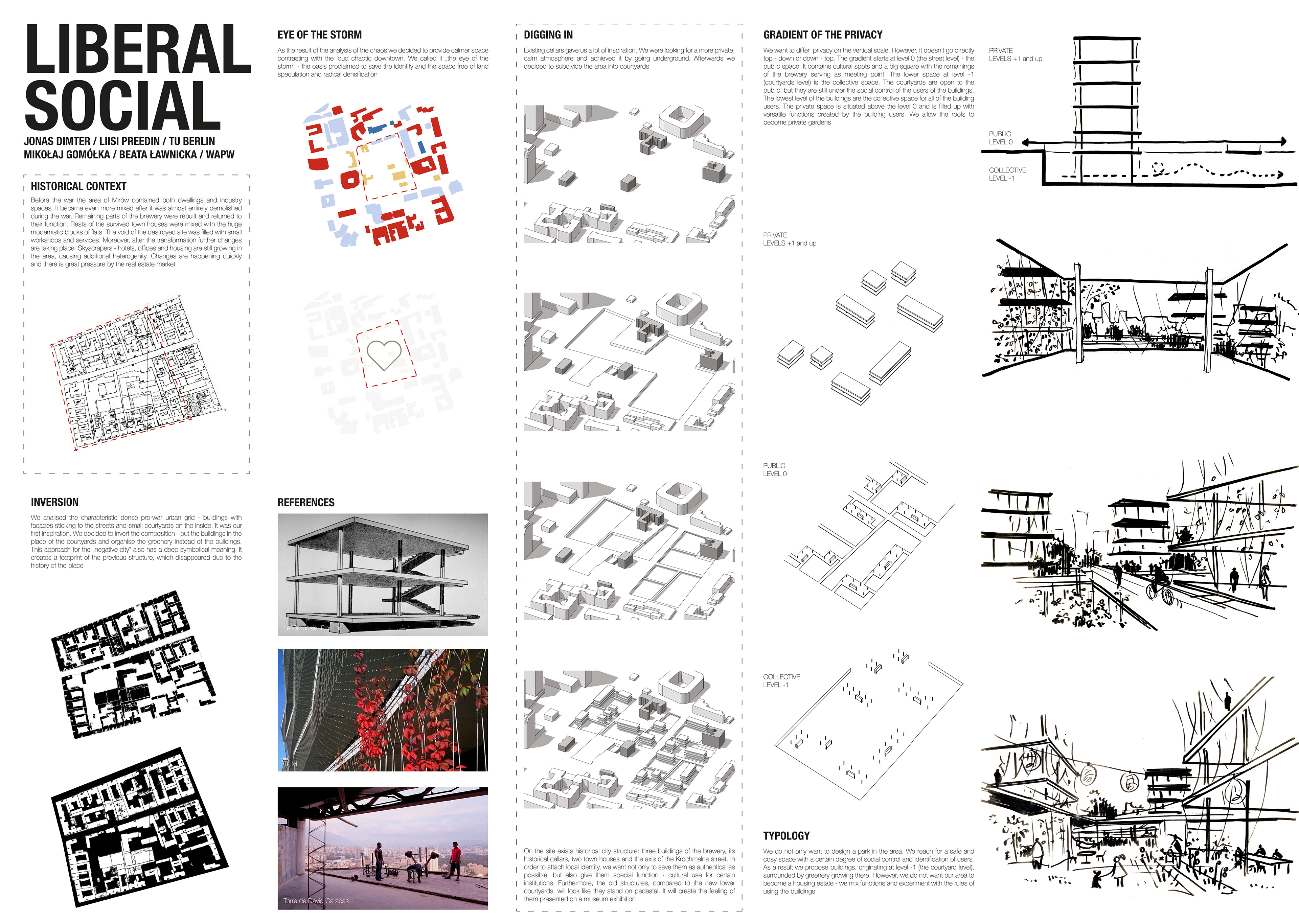
Before the war the area of Mirów contained both dwellings and industry spaces. It became even more mixed after it was almost entirely demolished during the war. Remaining parts of the brewery were rebuilt and returned to their function. Rests of the survived town houses were mixed with the huge modernistic blocks of flats. The void of the destroyed site was filled with small workshops and services. Moreover, after the transformation further changes are taking place. Skyscrapers - hotels, offices and housing are still growing in the area, causing additional heterogenity. Changes are happening quickly and there is great pressure by the real estate market
inversion.
We analised the characteristic dense pre-war urban grid - buildings with facades sticking to the streets and small courtyards on the inside. It was our first inspiration. We decided to invert the composition - put the buildings in the place of the courtyards and organise the greenery instead of the buildings. This approach for the „negative city” also has a deep symbolical meaning. It creates a footprint of the previous structure, which disappeared due to the history of the place
eye of the storm.
As the result of the analysis of the chaos we decided to provide calmer space contrasting with the loud chaotic downtown. We called it „the eye of the storm” - the oasis proclaimed to save the identity and the space free of land speculation and radical densification.
DIGGING IN
Existing cellars gave us a lot of inspiration. We were looking for a more private, calm atmosphere and achieved it by going underground. Afterwards we decided to subdivide the area into courtyards.
On the site exists historical city structure: three buildings of the brewery, its historical cellars, two town houses and the axis of the Krochmalna street. In order to attach local identity, we want not only to save them as authentical as possible, but also give them special function - cultural use for certain institutions. Furthermore, the old structures, compared to the new lower courtyards, will look like they stand on pedestal. It will create the feeling of them presented on a museum exhibition
gradient of the privacy.
We want to differ privacy on the vertical scale. However, it doesn't go directly top - down or down - top. The gradient starts at level 0 (the street level) - the public space. It contains cultural spots and a big square with the remainings of the brewery serving as meeting point. The lower space at level -1 (courtyards level) is the collective space. The courtyards are open to the public, but they are still under the social control of the users of the buildings. The lowest level of the buildings are the collective space for all of the building users. The private space is situated above the level 0 and is filled up with versatile functions created by the building users. We allow the roofs to become private gardens.
TYPOLOGY
We do not only want to design a park in the area. We reach for a safe and cosy space with a certain degree of social control and identification of users. As a result we propose buildings, originating at level -1 (the courtyard level), surrounded by greenery growing there. However, we do not want our area to become a housing estate - we mix functions and experiment with the rules of using the buildings.
CHOOSING THE USERS
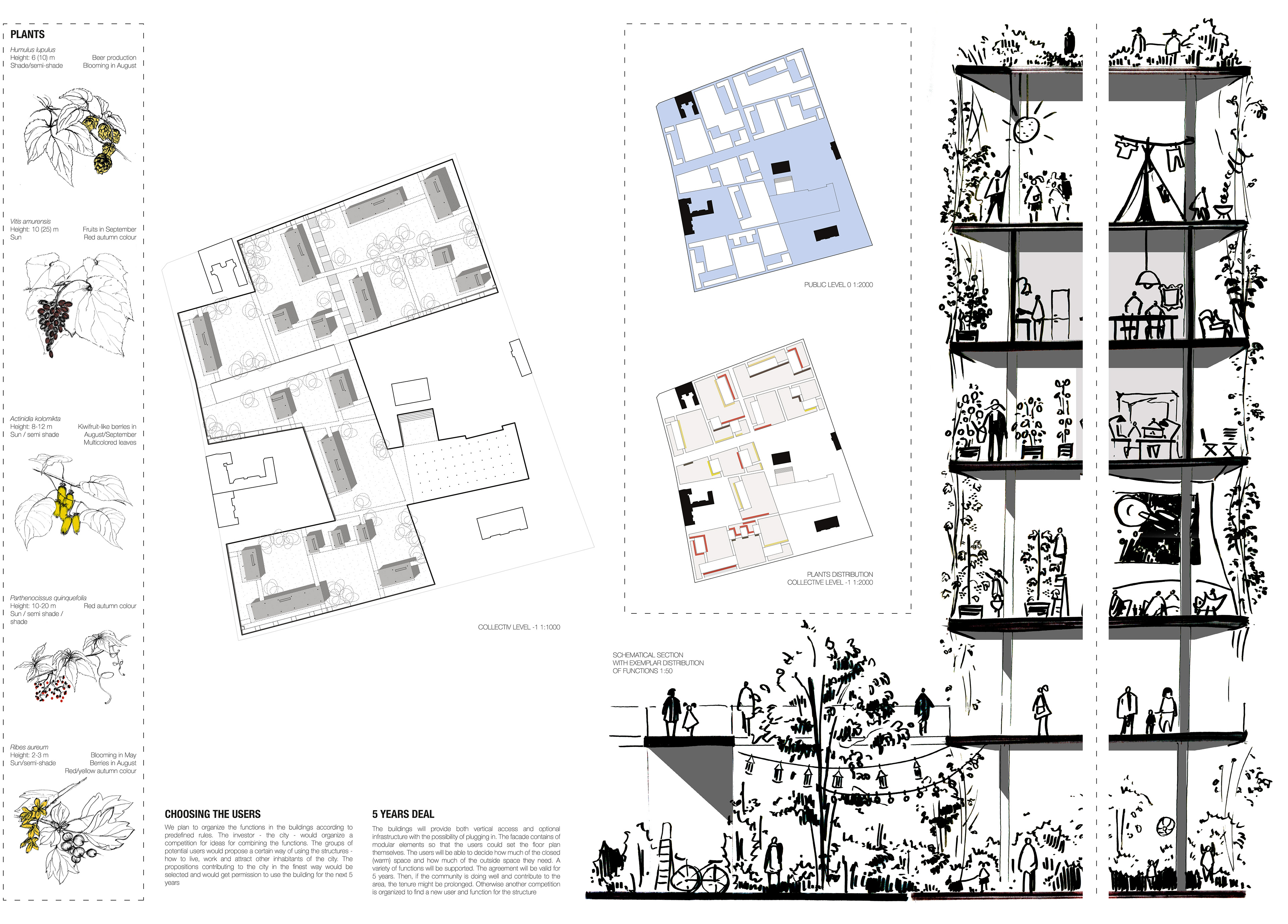
We plan to organize the functions in the buildings according to predefined rules. The investor - the city - would organize a competition for ideas for combining the functions. The groups of potential users would propose a certain way of using the structures - how to live, work and attract other inhabitants of the city. The propositions contributing to the city in the finest way would be selected and would get permission to use the building for the next 5 years.
5 YEARS DEAL
The buildings will provide both vertical access and optional infrastructure with the possibility of plugging in. The facade contains of modular elements so that the users could set the floor plan themselves. The users will be able to decide how much of the closed (warm) space and how much of the outside space they need. A variety of functions will be supported. The agreement will be valid for 5 years. Then, if the community is doing well and contribute to the area, the tenure might be prolonged. Otherwise another competition is organized to find a new user and function for the structure.